

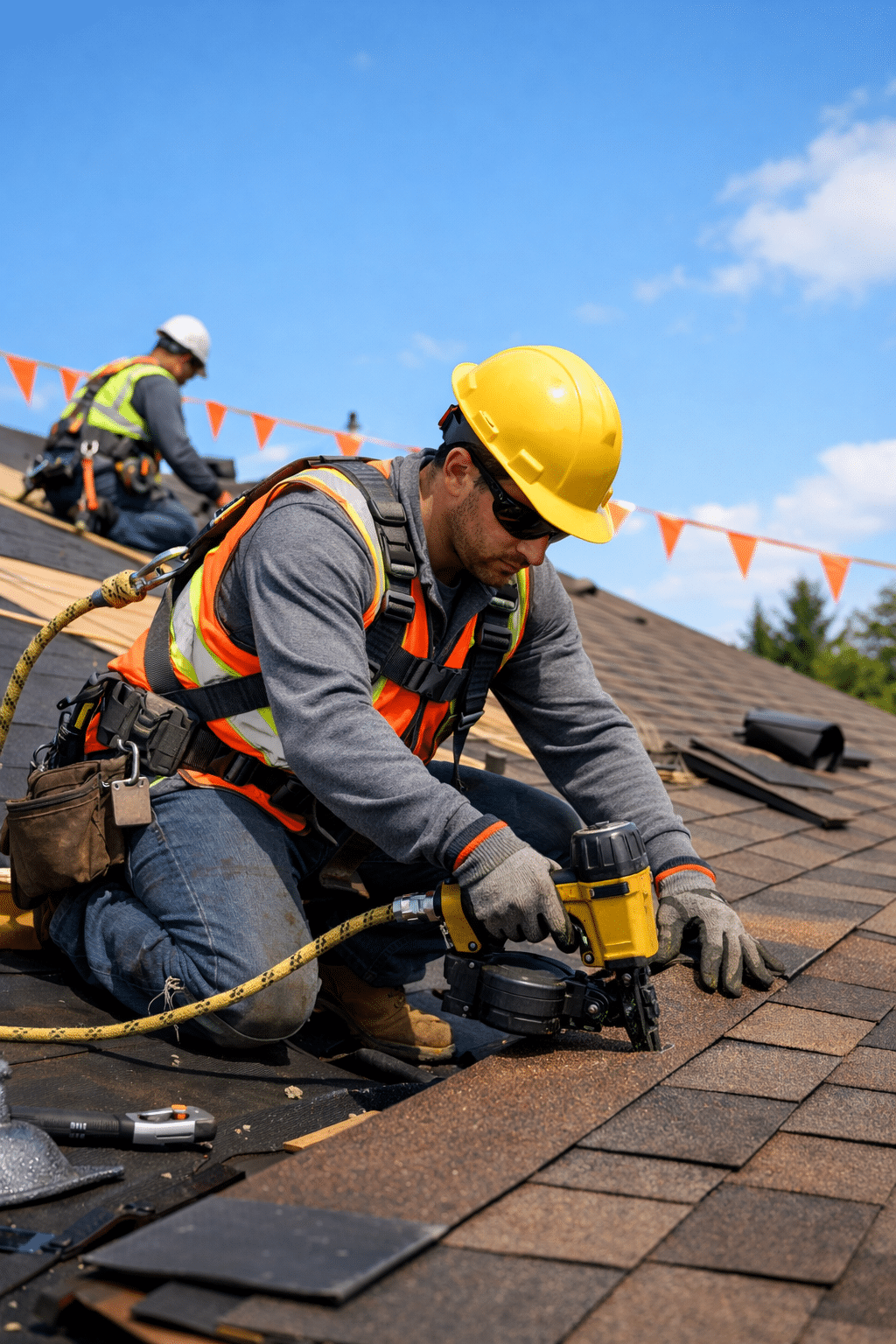
Hiring a roofer is one of the most important decisions a homeowner will make when planning a roof repair or replacement. While many people focus on price, materials, and how quickly the job can be completed, far fewer consider the legal and financial risks tied to choosing the wrong contractor. In Southern California, where roofing is one of the most hazardous construction trades, hiring a roofer who is not properly licensed or insured can expose homeowners to serious liability that goes far beyond the cost of the roof itself.
Accidents, injuries, and property damage occur more often than most homeowners expect. When a roofing contractor cuts corners on licensing, insurance, or labor practices, the responsibility for those risks can shift from the contractor to the homeowner — often without the homeowner realizing it until it’s too late.
Below are seven of the most costly mistakes homeowners make when hiring a roofer, and how to avoid them.
1. Hiring a Roofer Without Verifying the Proper License Classification
One of the most common mistakes homeowners make is assuming that any contractor license is sufficient. In California, contractors must hold the proper license classification for the work being performed.
Roofing work requires a C-39 Roofing Contractor license. Hiring a contractor who holds a different classification — such as a general “B” contractor — to perform only roofing work is a red flag. While B contractors may legally subcontract roofing as part of a larger construction project, they are not authorized to perform standalone roofing work unless they also hold a C-39 license.
Hiring a roofer without the correct license classification can expose homeowners to serious risks, including illegal work, failed inspections, denied insurance claims, and limited recourse through the Contractors State License Board (CSLB) if problems arise.
2. Hiring a Roofer Without Confirming Active General Liability Insurance
Licensing alone is not enough. Homeowners should also confirm that the roofing contractor carries active general liability insurance. This coverage helps protect against property damage or accidental losses that may occur during the project.
Verbal assurances such as “we’re insured” are not sufficient. Insurance policies can lapse, be canceled, or fail to cover the specific type of work being performed. Without valid coverage, homeowners may be forced to pay out of pocket for damages that should have been covered by the contractor.
3. Hiring a Roofer With Inadequate Workers’ Compensation Coverage
One of the most overlooked — and dangerous — mistakes when hiring a roofer involves workers’ compensation insurance. Some roofing contractors claim to carry workers’ compensation coverage, but not every worker on the job site is actually covered under that policy.
In some cases, contractors carry workers’ compensation “for appearances” only — covering themselves but paying laborers under the table, misclassifying workers, or using individuals who are not listed on the policy. If a worker is injured on your property and is not covered by valid workers’ compensation insurance, California law may allow that worker to pursue compensation directly from the homeowner.
This can include medical bills, lost wages, long-term disability costs, and additional legal damages. In certain situations, homeowners may even be treated as the employer — even if they had no knowledge that workers were uninsured.
4. Hiring a Roofer Based on Price Alone
Choosing the lowest bid often leads to the highest long-term cost. Roofing estimates that are significantly lower than others may indicate unlicensed labor, lack of insurance, skipped permits, or shortcuts in materials and installation.
What appears to be a savings upfront can quickly turn into expensive repairs, denied insurance claims, or legal exposure. A properly priced estimate reflects the cost of skilled labor, compliant installation, insurance, and accountability.
5. Hiring a Roofer Who Skips Permits or Inspections
Permits and inspections exist to protect homeowners and ensure roofing work meets safety and building standards. Contractors who suggest skipping permits to “save time” or “save money” are exposing homeowners to unnecessary risk.
Another major red flag is when a contractor asks the homeowner to pull the permit themselves. In California, the licensed contractor performing the work is responsible for obtaining the permit, not the homeowner. Asking a homeowner to pull a permit can indicate that the contractor is unlicensed, improperly licensed, attempting to avoid oversight, or shifting responsibility away from their business.
Unpermitted or improperly permitted work can lead to failed inspections, fines, forced corrections, denied insurance claims, and serious complications when selling a home. In many cases, homeowners — not the contractor — are held responsible for resolving permit issues, even if they were advised incorrectly.
6. Hiring a Roofer Without a Written Workmanship Warranty
A written workmanship warranty provides accountability after the job is complete. Homeowners should be cautious of contractors who offer vague promises or verbal assurances instead of clear, written warranty terms.
Without a written warranty, homeowners may have little recourse if leaks, installation issues, or defects appear after the project is finished.
7. Hiring a Roofer Without Proven Local Experience
Local experience matters. Roofing companies that have served the same Southern California communities for decades are far less likely to cut corners. Established local contractors maintain a physical presence, understand local building requirements, and stand behind their work long after the project is complete.
Contractors who appear briefly and disappear after finishing a job often leave homeowners with no recourse if problems arise later.
The Real Cost of Hiring the Wrong Roofer
Hiring the wrong roofer can lead to serious consequences, including personal liability for worker injuries, costly legal disputes, denied insurance claims, code violations, poor workmanship, unenforceable warranties, and complications when selling a home.
What may seem like a lower-cost option at the start can quickly become one of the most expensive mistakes a homeowner makes.
Why Hiring the Right Roofer Protects Your Home
At Weathertight Roofing Inc., protecting homeowners has been a core value since 1983. Being fully licensed and insured is not just a requirement — it is part of our commitment to doing the job the right way. We carry active general liability insurance and workers’ compensation coverage and operate with full transparency so homeowners are never exposed to unnecessary risk.
We proudly serve homeowners throughout the Inland Empire and surrounding communities, including Hemet, San Jacinto, Menifee, Murrieta, Temecula, Banning, Beaumont, Lake Elsinore, Yucaipa, and Sun City. Across every city we serve, we do not misclassify labor, pay workers under the table, or operate in gray areas. Every project is completed with professionalism, accountability, and attention to detail.
Hiring a roofer should protect your home — not create legal or financial exposure. Taking the time to verify licensing, insurance, and workers’ compensation coverage is not being difficult or distrustful; it is being responsible. Reputable roofing contractors welcome these questions because they understand the importance of homeowner protection.
If you are considering a roof repair or replacement and want confidence from the first inspection to the final cleanup, working with a properly licensed and insured roofing contractor makes all the difference.